





September 13, 2017
The new bridge is open for pedestrian traffic.
September 13, 2017

| Dates | Description |
|---|---|
| January 17 | - Overnight failure of the steel and concrete pedestrian bridge that spans a tributary of the Skokie River and connects Sleepy Hollow Park to Danny Cunniff Park. - Early morning, Park District crews secured entrances of bridge for safety & contacted an engineer for inspection of the cause. |
| January 18 – 19 | - Engineer inspection as well as inspection of all PDHP bridges was completed |
| January 20 - February 14 | - Emergency quotes were solicited and received by demolition and removal companies for the removal of the bridge. - Applied for and obtained City of Highland Park permits for the removal - Coordinated process for the demolition and removal company crane and trucks to come on site for the bridge removal. - Resident communication was distributed regarding the date and time of the removal and potential effect on traffic. |
| February 15 | - Bridge was removed |
| February 16 – April 5 | - Researched and interviewed engineering firms that specialize in waterway structural engineering to secure the most qualified and experienced firm that would deliver the project in the most efficient timeframe |
| April 6 – June 1 (8 weeks) | - Hey and Associates engineering firm that specializes in waterway structural engineering provided structural engineering services for the replacement bridge, construction bid documents, and permits from the United States Army Corps of Engineers, Illinois Department of Natural Resources, Lake Country Stormwater Management, and City of Highland Park (2 permits) for the replacement bridge. This process normally takes 12 weeks to complete however the Park District whittled down the engineering portion to 8 weeks. Permitting is still in progress. |
| June 2 – June 20 | - The project is out for bid. Bids are due Tuesday, June 20. |
| June 27 | - Expected bid winner approved by the Park Board at the June 27 meeting. |
| June 28 – September 1 | - Bridge fabrication. Manufacturing a bridge of this type takes between 8-14 weeks. The Park District specified an expedited eight-week time frame in the bid. |
| TBD | - Shipment, delivery and installation of bridge at Sleepy Hollow. |
Since the grand re-opening of the beach in the summer of 2015, Rosewood Beach has received local, state and national recognition. Awards include:
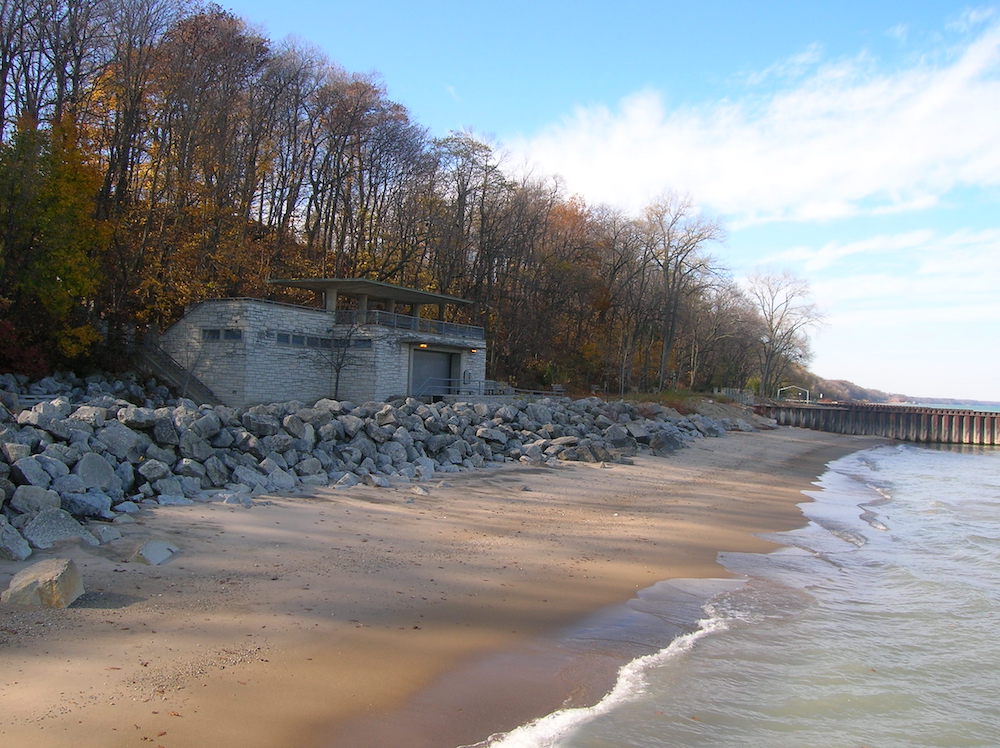
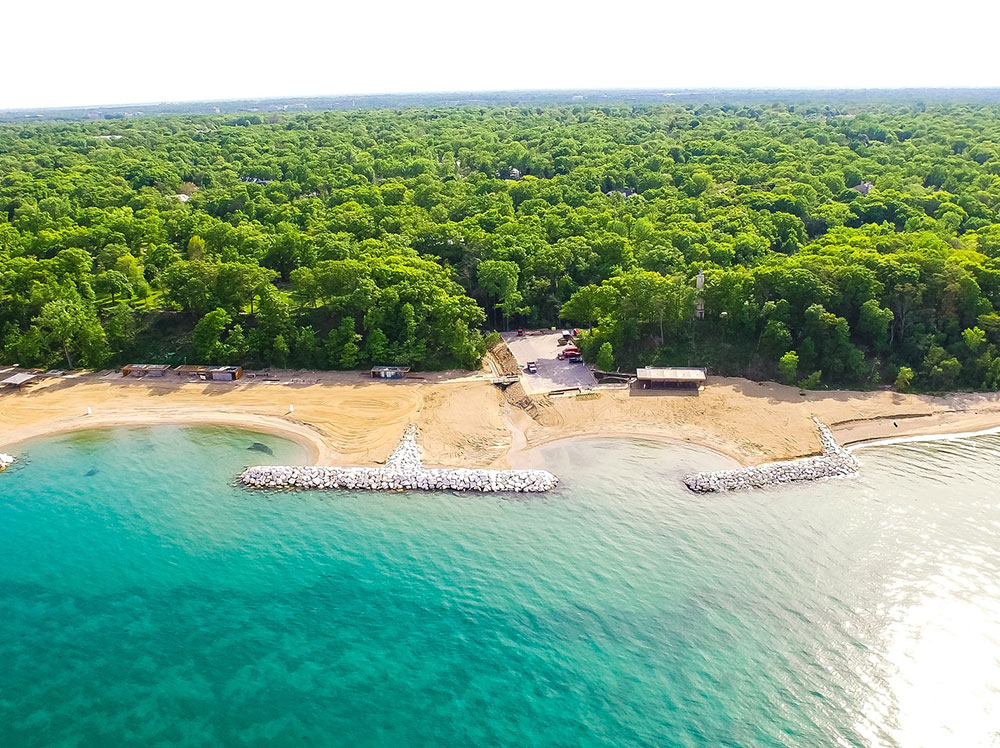
The project was a collaborative effort between the park district and the United States Army Corps of Engineers (USACE) as part of the Great Lakes Fishery and Ecosystem Restoration (GLFER) program. The USACE constructed breakwaters extending 200 feet into the lake forming three protected coves –nature, swimming and recreational.The beach was also expanded with 65,000 cubic yards of added sand. The park district’s portion of the project included the construction of new environmentally friendly facilities including a one-of-a-kind beachfront Interpretive Center, concessions, restroom, and guard buildings — all connected by a 1,500 foot long boardwalk and nestled against the wooded bluffs.
Local school field trips and the district’s nature-based classes and camps utilize the Interpretive Center – part of the district’s initiative to build an informed, inspired, and engaged community that recognizes the need to protect the Lake Michigan coastal zone. The center is open to the public during busy beach days and serves as a shelter during inclement weather. Interpretive panels along the outside deck detail Rosewood’s living classroom and the Lake Michigan coastal zone.
The daylighted ravine stream provides rare nearshore fish habitat and allows cleaner water to flow into the lake. The bluff, ravine, and beach were also restored to improve the health of the unique ecosystem; and a new permeable paver parking lot decreases runoff and naturally cleans storm water.
The “new” Rosewood Beach is a lasting legacy of Highland Park’s commitment to environmental stewardship, recreation and education. The project is a role model for ecological best practices and showcases how a collective vision can be transformed into a shared reality.
As one of only 14 Illinois communities on Lake Michigan, preserving this dynamic and vulnerable open space has been a priority of the Park District of Highland Park for over 100 years. The purpose of the Rosewood Beach renovation was to revitalize the community’s swimming beach and protect the delicate bluff, ravine, and beachfront that were in danger of being swept away forever.
The Rosewood property was donated to the district in 1928 by Julius Rosenwald, chairman of Sears, Roebuck Co. In 1945, the Rosenwald children donated $25,000 for construction of a beach house.
Over the decades, harsh conditions took their toll on the beach and beach house. The crumbling building was demolished in 2006. Unfortunately, this left the community’s swimming beach with no functioning restrooms. Steel sea walls provided little protection to the eroding beach. The ravine and bluff suffered greatly from damaging flooding and declining native habitat.
A 2007 Lakefront Master Plan called for sweeping renovations of the Rosewood, however the 2008 economic downturn delayed the plan. In 2011, the project gained traction when the district partnered with the USACE, and a resident task force was appointed to guide the building development process.
In May 2012, the task force presented to the community a unique minimalistic design plan blending the infrastructure into the environment and allowing the lake to be the main focus. The Board approved the recommendation in August 2012. Construction began in October 2013 and the new Rosewood Beach opened to the community in June 2015.
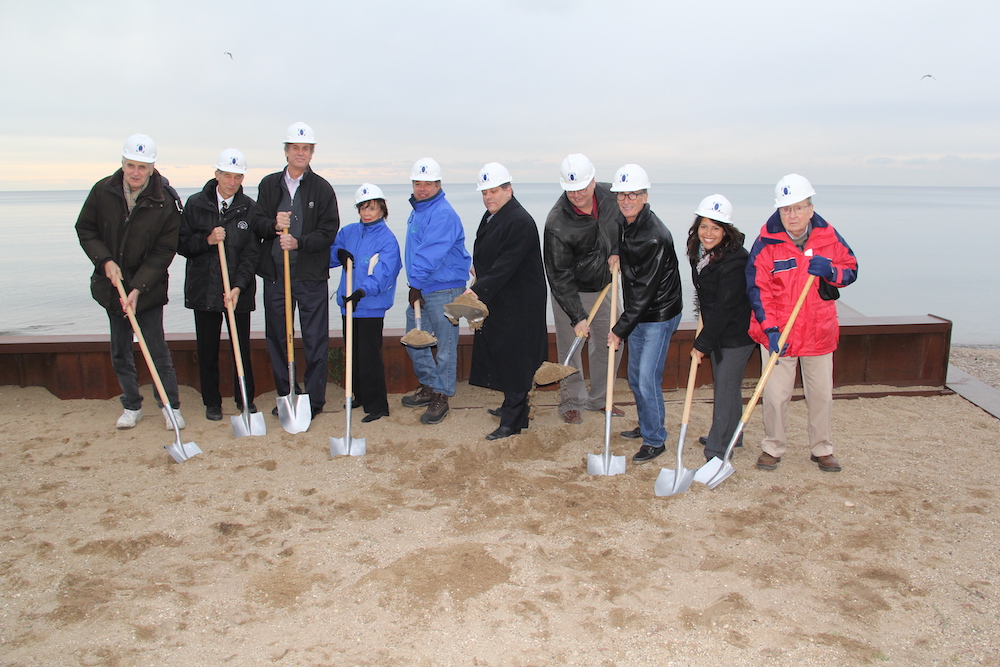
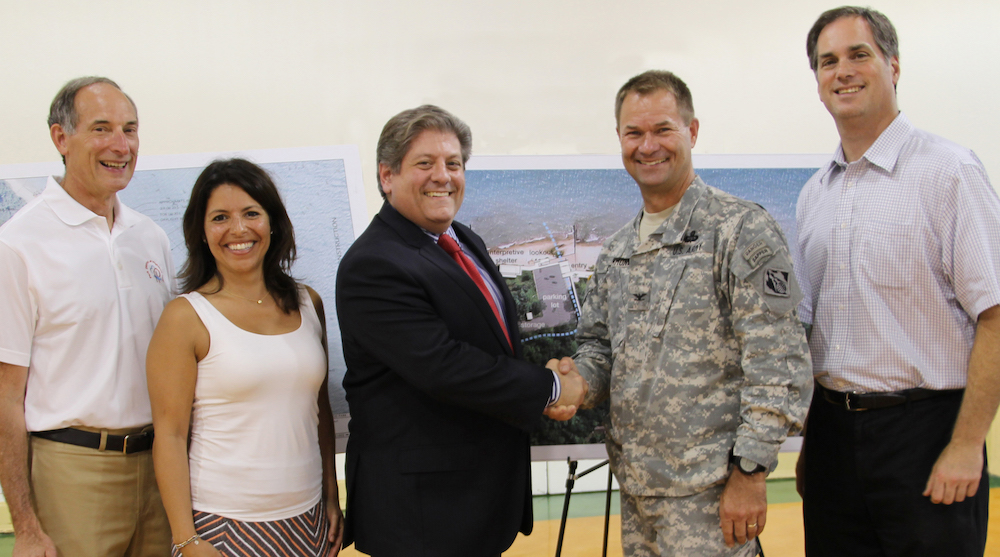
The Rosewood Beach restoration was the result of a comprehensive plan where community involvement played a key role in the ultimate outcome. It was vitally important to the Park District of Highland Park to continue a long-held practice of seeking ongoing conversations and input from the community for the project.
The overarching vision for the Rosewood project was initially formed through the district’s 2007 Lakefront Master Plan. The plan was developed over a nine-month period by a Lakefront Planning Commission which included representation from the local, state and federal levels. The commission solicited resident input throughout the planning process. More than 700 Highland Park residents shared their thoughts in surveys and at input meetings which laid out the vision for the lakefront.
In 2011, when the Rosewood project planning began, a resident volunteer “Rosewood Task Force” was recruited and met regularly for over a year to develop the extraordinary design plan. Regular open meetings encouraged resident participation. Two open houses were also held for resident questions and input. Progress from the group and solicitation for comments were promoted through the district website, press releases, mailings and emails. More than 200 residents participated in the meetings and submitted comments and questions.
A grassroots resident group “Friends of Rosewood” was also formed by three concerned citizens to support the project and help move it along to approval. This group played a pivotal role educating and energizing residents to support the plan through their website, social media, and email updates. Through the hard work of “Friends of Rosewood Beach” support of the project quickly grew to more than 300 involved families.
The community-wide grand opening for Rosewood was held on June 6, 2015. Hundreds of families made their way to the beach on that sunny clear day. Some came to revisit a childhood destination, and some came out of pure curiosity to see in amazement what was done to the once diminished beach. The response was dramatic, joyful, and heartfelt. “WOW!” was the emotion that reverberated over the grand opening crowd. Residents now lap up the lakefront like never before.
The Park District chose the architect for Rosewood via an unconventional design competition. Eleven firms submitted design concepts to the task force with the project ultimately awarded to Chicago-based Woodhouse Tinucci Architects. The firm worked alongside the USACE and the park district to develop a plan meeting the community’s programmatic and environmental stewardship needs for the lakefront.
Woodhouse rejected the conventional idea that all functions should be served in one building. Instead, they created a beach walk integrated as a landscape element, not a building. Rosewood became in essence a “walk in the park.” The boardwalk hugs the bluff, connecting the ravine trail to the north with the bluff stairs at the south – affording continuous access to the beach along its vast open east side facing the lake. A series of four, small, low-profile buildings pulled back to the bluff preserves views 20 miles to the south and 40 miles to the north. This created a landscape in which the built environment absorbed into the natural environment instead of competing with it.
The beachfront is anchored by the 1,500 foot-long boardwalk that leads visitors to the buildings, beach, and Rosewood Park perched atop the bluff. The boardwalk was constructed from ipe, a sustainably forested dense South American wood, and features built-in loungers, benches, and picnicking areas. The Interpretive Center, lifeguard station, concessions, and restrooms are designed as compact, cedar, bird friendly glass and natural stone structures complementing the natural surroundings.
The Interpretive Center overlooking the nature cove features three sliding glass walls offering dramatic 180 degree panorama up and down the beach and to the lake’s horizon. Geothermal technology heats and cools the year-round facility. To mitigate bird collision, bird-friendly glass was installed in all of the buildings. The glass features a patterned, UV reflective coating making it visible to birds but virtually transparent to humans, thus allowing undisturbed views of Lake Michigan from inside the buildings. Low-energy L.E.D. lighting is used throughout the site.
The Interpretive Center is equipped with up-to-date scientific equipment, funded in part through a State of Illinois Coastal Management Program education grant, including projecting microscopes, site Wi-Fi, computers and a 70-inch flat screen monitor which communicate the Rosewood conservation efforts in progress.
The shoreline plan included new low-profile stone breakwaters, extending 200 feet into Lake Michigan. These barriers provide erosion protection to support dune structures and native plantings and created three beach coves greatly expanding recreational and interpretive opportunities enabling the park district to simultaneously offer a variety of programming options.
To build the breakwaters, barge loads of 4-6 ton stones were hauled to the site. The stones were carefully selected to interlock forming the protective seawall. Stones were placed individually by cranes from on-shore and marine-based platforms.
More than 65,000 cubic yards of sand were trucked to the beach over a four-month period. Laser guided machinery was used to grade the sand. As a result, the Rosewood recreational beachfront doubled in size where once only rock rose from the water.
Renovating Rosewood Beach was a priority for the Park District of Highland Park and the community. The 2007 Lakefront Master Plan prescribed sweeping renovations to Rosewood. Results of the 2009 Communitywide Attitude and Interest Survey showed that more than 50% of residents ranked the need for a lakefront swimming beach, ravine and bluff system as a top priority. The renovation of Rosewood Beach not only met the community’s needs for environmental stewardship, outdoor recreation, and nature education, but it also serves as a role model for ecological best practices and showcases how a collected vision can be transformed into a shared reality.
The once deserted swimming beach is now bustling with activities. Residents take part in beach yoga and deep water swimming. Summer camps, year-round preschool programs and family events provide fun and education. With the new concessions and restroom buildings, community members can spend a clean, safe and enjoyable day at the beach. Friends and family can gather for beach picnics while soaking in the sun and the amazing lakefront.
Increased visitation to Rosewood has also resulted in a bump for the local economy especially to the adjacent Ravinia Business District. Increased traffic to Rosewood prompted the city to contribute to a revitalization of the Ravinia District.
The new Rosewood also made a positive impact to the natural environment. Energy efficient lighting and geothermal heating lighten energy demands now and into the future. Innovative permeable paving in the parking lot will prevent thousands of gallons of runoff from washing into Lake Michigan – helping to keep drinking water clean for the millions of people who rely on it.
The protected coves and opened ravine stream provide healthy fish habitat and cleaner water. In April, for the first time in 40 years, native lake fish made their way up the now accessible ravine stream to spawn. Residents contacted the park district with their excited tales of big fish and new life that had been brought back to the stream.
Nearly 20,000 native plants were planted by hand along the bluff and stream to prevent erosion and pollutants in the stream. On the beach, American beach grasses and sand reeds will now promote small dunes that were once a vital habitat along Illinois’ shoreline.
This summer, a colony of Bank Swallows, an uncommon breeder in our area, made nests along the ravine stream sand walls. Chicago Botanic Garden volunteers also identified two rare beach plant species growing at Rosewood.
To protect the new shoreline, the park district and USACE implemented a 5-year sand monitoring program. The program will detect any sand erosion so future infrastructure adjustments can be made if needed.
Rosewood is a new found social and recreational destination and a source of pride for Highland Park. Rosewood’s impact, whether it be programs at the Interpretive Center, recreation on the beach or just a quiet stroll along the boardwalk, will carry throughout the community for generations to come.
The Great Lakes — including Lake Michigan — are a tremendous national resource not only for the vast amount of the earth’s freshwater they contain but for their natural beauty and the recreational opportunities they offer. Preserving this dynamic yet vulnerable open space and meaningful access to it for the community and for future generations has been an priority of the Park District of Highland Park for more than 100 years.
We shared a vision with our residents to create much more than just a swimming beach at Rosewood. Together, we delivered a unique facility that blends modern recreation components with protection of the natural environment. We engaged the public in stewardship of our Great Lake through the creation of a living classroom—featuring a sustainably-built Interpretive Center ready for science-based experiential learning. Together, we lead by example through restoration of the unique habitats of ravine and bluff that are the hallmark of our lakefront while using ecological development practices to protect them.
Most importantly, we accomplished the goal of connecting residents with their lake. Today, students from area elementary and high schools come to Rosewood to learn about issues of water quality, fish habitat and ravine life. Residents participate in early morning yoga classes on the beach, take part in year-round environmental programs, experience deep water swimming, and join in lively games of beach volleyball. Children splash in the waves at the protected swimming cove and play at the beach playground.
Rosewood boosts innovative designs and forward thinking ideals, but is a reflection of a century-old dedication to the community and commitment to the environment that is at the core of the Park District of Highland Park.
Thank you Rosewood Beach Task Force for the time and energy you have devoted to this project.
Task Force members included Chairman Dave Fairman, Ben Kutscheid, Jeff Orlove, Barnett Ruttenberg, Steven Sider, Eve Tarm, and Edmond Zisook. Park Board Commissioners Elaine Waxman and Lori Flores Weisskopf were ex officio members.
The Park District is working with The Lakota Group on a site concept plan for Park Avenue Beach (both the north and south beaches). The Plan is an initiative from the Lakefront Master Plan Update, that considers access, boat storage and amenities, passive and/or active recreation, infrastructure repair and replacement and is also consistent with the District’s Beach Management Plan. The Park Avenue Site Plan does not include specific engineering, architectural or construction plans (such as the replacement of the boat launch and barge). However, it does represent these projects as current planning initiatives and incorporates them into the overall site and capital plan.
The concept plan was approved by the Park District Board of Commissioners on August 24. Click below to view the concept plan. The Plan is unfunded at this time; with an approved plan, the Park District can begin to identify possible funding opportunities. The project team is finalizing a summary plan report. Once complete, the report will be posted here.
Please note: The barge breakwater/boat launch is a separate project. Learn more about the Breakwater/Launch Project
The Park District is collaborating with:
The Park District Board of Commissioners approved the Park Avenue Beach and Boating Facility Site Master Plan Report.
The Park District Board of Commissioners approved the Park Avenue Site Concept Plan.
Thank you to those that attended the Park Ave Site Improvement Plan Community Meeting on Monday, August 16, from 6:30 – 7:30 pm. We had over 75 people participate and collected valuable feedback on the plan.
This community meeting was held to review the proposed concept site plan for the Park Avenue Beach and Boating Facility. The meeting included a brief introduction of the concept plan followed by an opportunity to take a closer look, ask questions, and provide feedback to the project team.
If you were not able to join, click here to watch the recorded meeting. The Park District has heard from many residents, and the slide below summarizes the trending comments. This slide is not intended to be an exhaustive list of all comments received but a snapshot. Please send comments and questions to [email protected].